How to beat the market: a practical guide
By insiderz10 min read
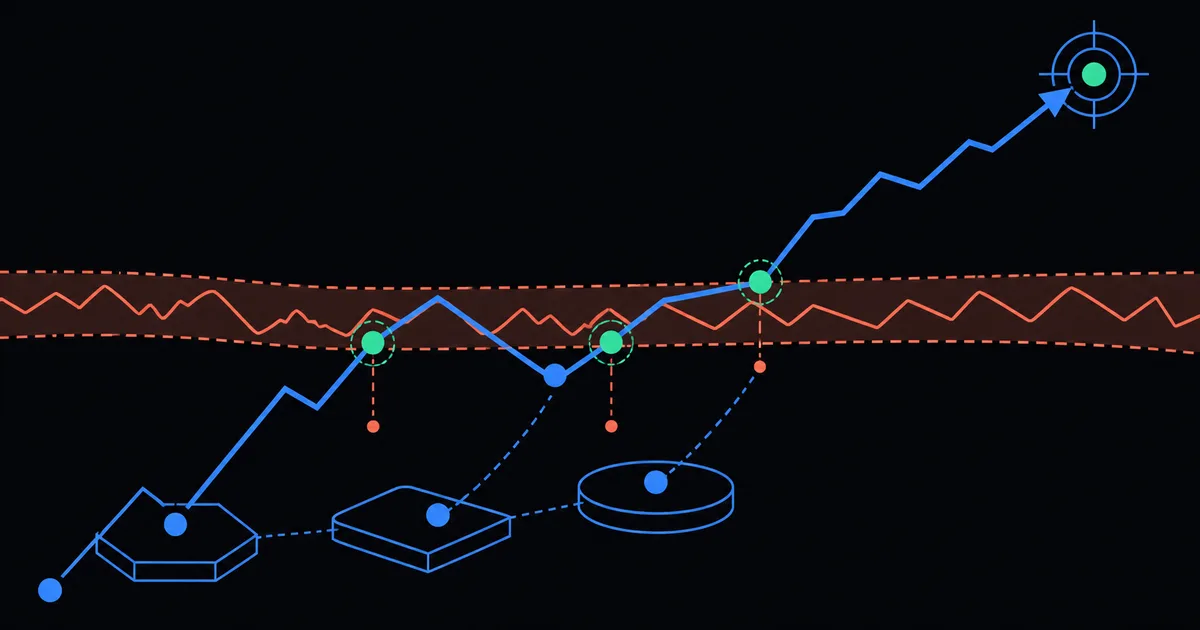
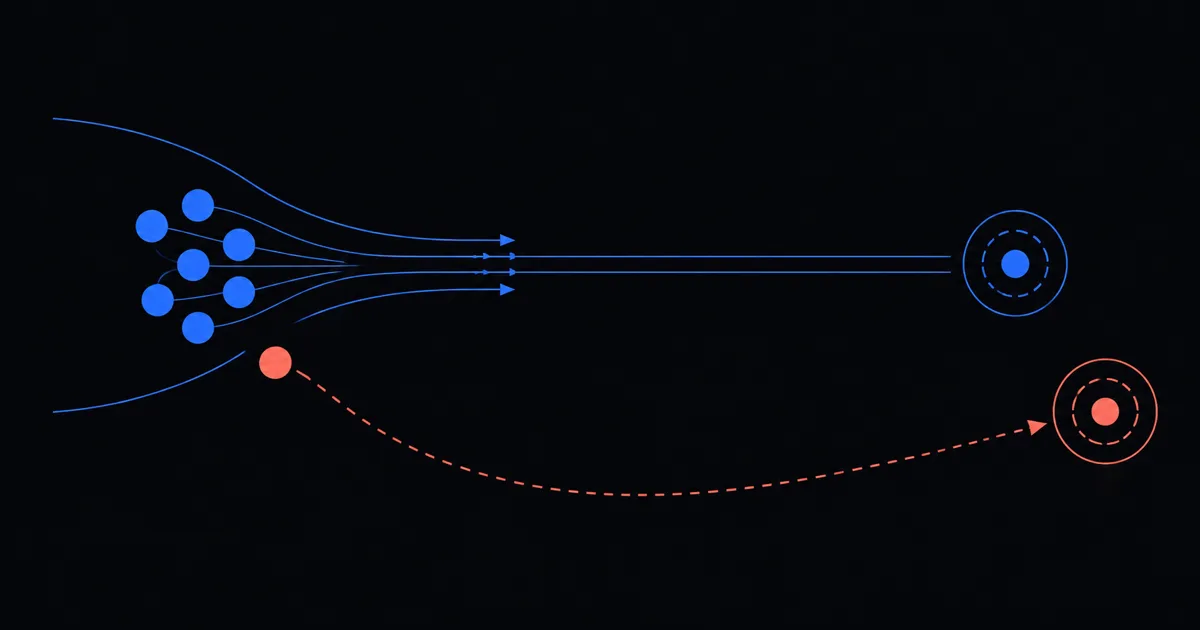
Beating a prediction market means being right where the price was wrong, often enough and on enough events that luck stops being the explanation. There is no trick that works everywhere. What works is a method: start from the price rather than your opinion, disagree only in the few situations where prices are known to be soft, put a specific number on it, and score every call against the price at the moment you made it.
What does beating the market actually mean?
It means your probability was closer to the outcome than the market's probability was, measured on the same event, at the same moment, over many events.
That definition rules out two things people usually mean by it. It is not "I called it", because a single correct call at 40 percent proves nothing. And it is not profit, because profit depends on stake size, timing and liquidity, so a bad forecaster with a large position can outrank a good forecaster with a small one. The comparison that carries information is your number against the price, on the same question, repeated.
The bar is real but it is not uniform. In a study of more than 2,500 political markets across four exchanges during the final five weeks of the 2024 US presidential campaign, posted to SocArXiv on 1 December 2025, Joshua Clinton and TzuFeng Huang found that 93 percent of PredictIt markets predicted the outcome better than chance, against 78 percent on Kalshi and 67 percent on Polymarket. They also found prices for identical contracts diverging across exchanges and arbitrage opportunities peaking in the last two weeks. The crowd is good. It is not a wall.
Why start from the price and not from your opinion?
Because the price already contains most of what you know, and your job is to find the part it does not.
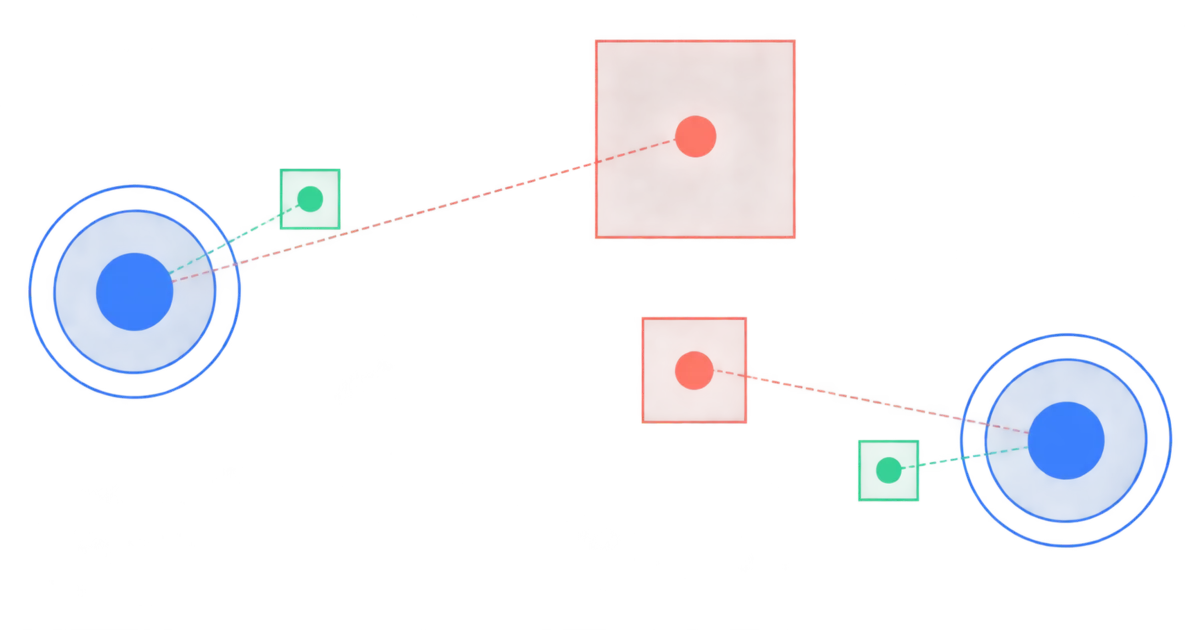
The practical order is fixed. Write your own probability first, before you look at the market. Then look at the price. Then explain the gap in one sentence: what do I know or believe that the crowd does not, and why has it not been priced. If you cannot write that sentence, there is no call to make.
Doing it in the other order destroys the evidence. If you read 63 percent and then form an opinion, your opinion will land near 63 percent, and you will have learned nothing about your own judgment. This is also why a record built on calls made after seeing the price, with no record of what the price was, tells you nothing later.
The single most valuable habit here is the cheapest: state a number. Not "I think this happens", but "68 percent". In the Good Judgment Project, superforecasters used an average of 57 distinct probability values across their questions, against 29 and 30 for the two comparison groups, and were the group most likely to use values divisible by 1 percent rather than rounding to multiples of 10, as documented by Mellers and colleagues in 2015. Granularity is not decoration. It is the difference between a view and a forecast.
Where is the market actually beatable?
Six situations, and outside them the honest move is to say nothing.
- Thin markets nobody is watching. Low volume, wide spread, a price that has not moved for days. The price is a few people's opinion, not a crowd's.
- Information the crowd is slow to price. Prediction markets move in the right direction immediately after news and then keep moving. In a study of 1,438 NBA games and 2,876 contracts on Kalshi published on arXiv on 5 June 2026, Giovanni Angelini and Luca De Angelis found that a one-minute change in the benchmark win probability produced only about a 0.64-for-one contemporaneous change in the market price, with roughly 2.0 percentage points of further adjustment arriving over the next five minutes. They also found that underreaction was substantially larger when liquidity was low.
- Questions that need domain knowledge. When the answer sits inside a closed group, volume does not help. Robert Prevost went into the 2025 papal conclave priced under 1 percent on Kalshi and was elected pope on 8 May 2025, while the two platforms handled over $40 million between them, CNBC reported on 10 May 2025.
- Resolution wording nobody read. A market resolves on its rules text, not its title. A Polymarket market on whether Volodymyr Zelenskyy would be photographed wearing a suit before July drew $237 million of volume and resolved No on 1 July 2025. Reading the rules is not forecasting, and it is often worth more.
- Longshots priced too high. At the far end of the scale, small probabilities attract more attention than they deserve. An outcome at 2 or 3 percent frequently has no reference class supporting even that.
- Reflexive markets. When the price is being quoted as an argument inside the event it measures, it has stopped being an independent estimate.
Each of these is unpacked, with the evidence, in when is the market wrong.
Base rates first, news second
A base rate is how often things in this class have happened before, ignoring the specifics of this case. It is the cheapest forecast available and it is usually better than the one people produce by reasoning from the story in front of them.
The order matters. Find the reference class, write down the historical frequency, and only then let the current news move you off it. Done the other way round, the news becomes the whole forecast and the base rate becomes a decoration you add afterwards to feel rigorous.
Two rules keep this honest. Pick the narrowest reference class that still has enough past cases to count, and write it down before you look at the answer. If you find yourself narrowing the class until only supportive cases remain, you are no longer using a base rate.
How do you decompose a question?
Decomposition means replacing one question you cannot estimate with several you can.
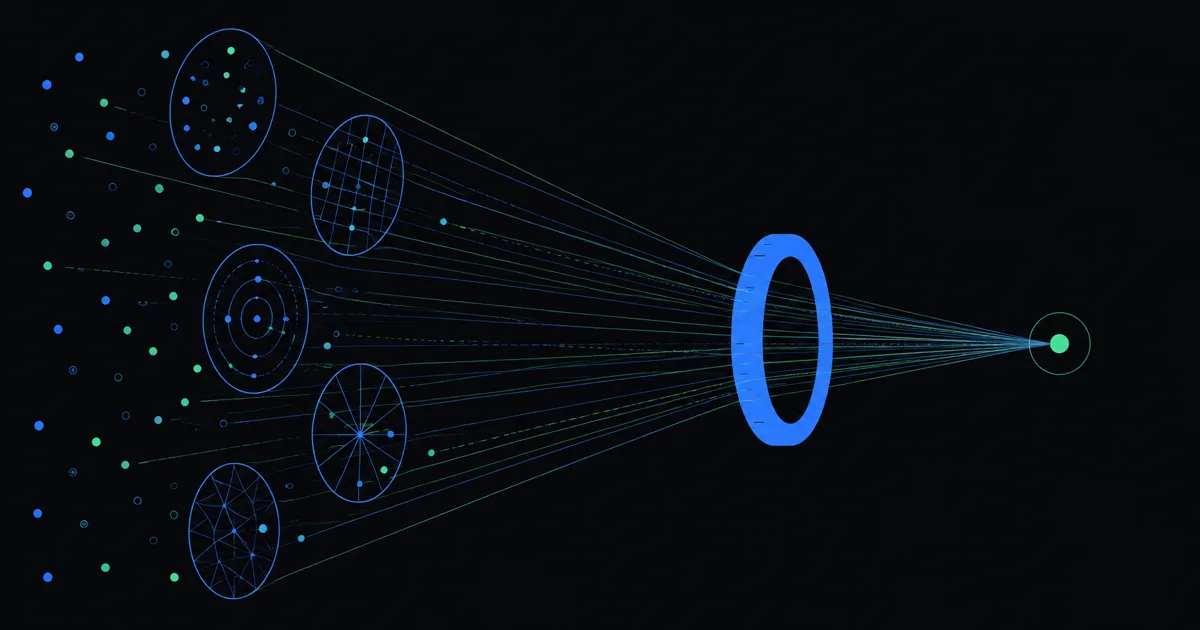
"Will the deal close this quarter" is a lump. Broken up it becomes: has the regulatory filing been made, does the counterparty have a financing condition outstanding, how long have comparable deals in this sector taken from filing to close, is there a stated deadline with teeth. Each part has a rough frequency. Combine them and you have a number that came from something.
The real payoff is that decomposition tells you where to spend your time. When you write out four sub-questions and one of them carries almost all the uncertainty, you have found the only research worth doing. It also gives you a place to put new information: most news bears on one sub-question, not on the whole.
How sure should you say you are?
As sure as your record supports, and no surer.
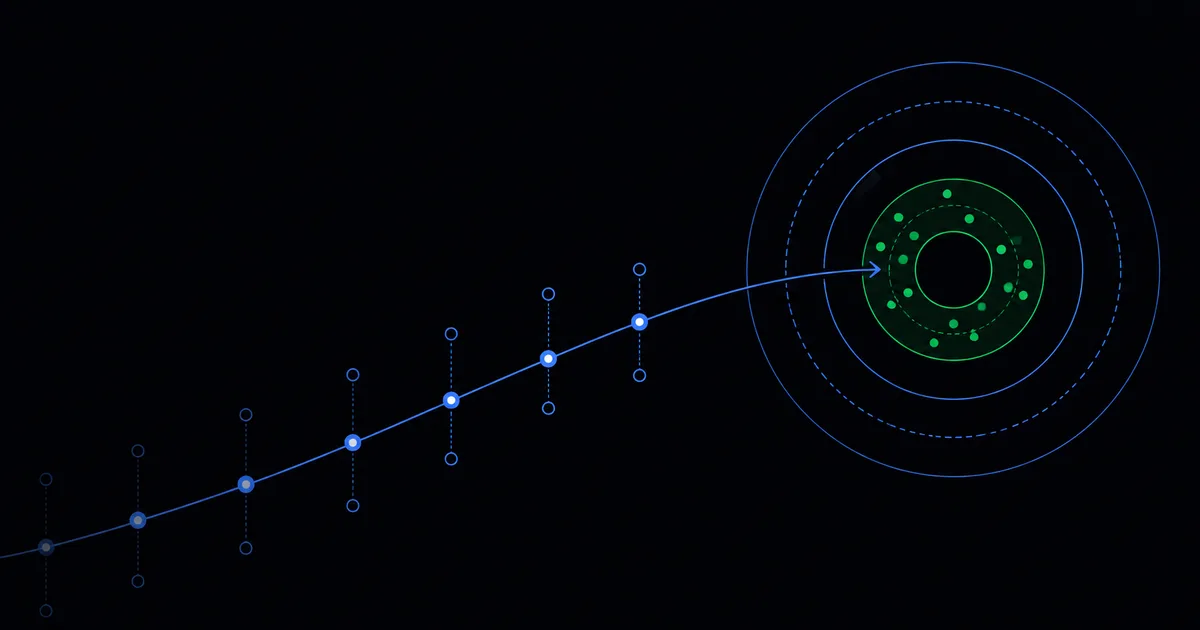
The common error is overconfidence, and it has a specific shape: your high-confidence calls come true less often than you claimed. If your 90 percent calls land at 75 percent, your 90 is really a 75, and writing 90 costs you every time. The fix is arithmetic, not willpower: group your resolved calls into confidence bands, check the hit rate in each band, and shift the bands that miss. The full method is in calibration explained.
The opposite error is cheaper to spot and just as useless. Saying 50 percent scores as a coin flip forever, which means it can never be wrong and can never demonstrate anything. If you are not willing to move away from 50, do not make the call.
Two habits sit between the extremes. Update often and in small steps: frequency of belief updating was the strongest single behavioural predictor of accuracy in the Good Judgment tournament data. And never write 0 or 100, because a probability of zero on something that happens is the one error that no amount of good work can offset.
How do you keep score?
Three requirements, and if any one is missing the score is not evidence.
- The forecast is timestamped and cannot be changed. A record you can edit or delete measures nothing except what you chose to keep.
- The benchmark is captured at the same moment. Scoring against the price as it was when you called is what removes the difficulty of the question from your result. Scoring against the closing price flatters or punishes you for things you could not know.
- Every call counts, including the bad ones. Selective reporting is the default failure of public prediction, and it is invisible from the outside unless the platform makes deletion impossible.
The metric underneath is the Brier score, and the version that answers "compared to what" is the relative one: your score minus the benchmark's score on the same events. On insiderz that is the Edge column, and Beats market is the simpler count of how often you came out ahead of the price.
What does beating the market look like over 50 calls?
It looks less dramatic than people expect, and it takes longer to prove than people expect.
Suppose you record only whether you beat the price on each resolved call, ignoring by how much. If you had no skill, you would beat the price about half the time. The table below shows how far above half you need to be before the result clears two standard errors under that fair-coin assumption, which is a rough stand-in for "not luck".
| Resolved calls | Hit rate that clears two standard errors | Minimum calls beaten | Same as |
|---|---|---|---|
| 10 | 81.6 percent | 9 | 9 of 10 |
| 25 | 70.0 percent | 18 | 18 of 25 |
| 50 | 64.1 percent | 33 | 33 of 50 |
| 100 | 60.0 percent | 61 | 61 of 100 |
| 200 | 57.1 percent | 115 | 115 of 200 |
| 400 | 55.0 percent | 221 | 221 of 400 |
Method: normal approximation to the binomial, null hypothesis that you beat the price half the time, threshold set at two standard errors above 0.5. Computed for this article in September 2026. It is a rough guide, not a significance test you should publish.
Read the first row and the last row together. Ten calls proves nothing unless you were right nine times, which mostly happens by luck. Four hundred calls at 55 percent is a real, boring, valuable edge. That gap is why a person with a long dull record is worth more than a person with three spectacular screenshots.
There is one more finding worth carrying. In Crowd prediction systems: Markets, polls, and elite forecasters, published in the International Journal of Forecasting in 2024, Atanasov, Witkowski, Mellers and Tetlock found that small elite crowds beat large non-elite ones in both prediction markets and prediction polls, while the two mechanisms were statistically tied with each other. The elite aggregate scored a Brier score of 0.166 against 0.228 for a non-elite crowd of over 300 people on the same questions. Who is forecasting matters more than the machinery around them, which is the whole argument for finding the few people with a record instead of averaging everyone.
Where can you practise?
You need events that resolve, a price to beat, and a record you cannot tamper with.
On insiderz you make calls on the same events Polymarket lists, with no money involved and nothing to bet. A call is yes or no plus how sure you are. It is locked the second you post it, with the time and the Polymarket price at that moment frozen beside it, and it cannot be edited or deleted. When the event resolves, the call is scored against that frozen price. Calls go public after a delay, and followers with live access see them the moment they are made.
The insiders leaderboard ranks people on Beats market, Events, Edge and Early. Bots can play through the public API under the same rules and appear in the same ranking. Open events are here.
Open events right now
Live from insiderz.Democratic Presidential Nominee 2028
PoliticsCloses 0 calls
- Alexandria Ocasio-Cortez · Will Alexandria Ocasio-Cortez win the 2028 Democratic presidential nomination?
- Jon Ossoff · Will Jon Ossoff win the 2028 Democratic presidential nomination?
- Gavin Newsom · Will Gavin Newsom win the 2028 Democratic presidential nomination?
Presidential Election Winner 2028
PoliticsCloses 0 calls
- JD Vance · Will JD Vance win the 2028 US Presidential Election?
- Alexandria Ocasio-Cortez · Will Alexandria Ocasio-Cortez win the 2028 US Presidential Election?
- Jon Ossoff · Will Jon Ossoff win the 2028 US Presidential Election?
Republican Presidential Nominee 2028
PoliticsCloses 0 calls
- J.D. Vance · Will J.D. Vance win the 2028 Republican presidential nomination?
- Marco Rubio · Will Marco Rubio win the 2028 Republican presidential nomination?
- Tucker Carlson · Will Tucker Carlson win the 2028 Republican presidential nomination?
Brazil Presidential Election
PoliticsCloses 0 calls
- Luiz Inácio Lula da Silva · Will Luiz Inácio Lula da Silva win the 2026 Brazilian presidential election?
- Flávio Bolsonaro · Will Flávio Bolsonaro win the 2026 Brazilian presidential election?
- Augusto Cury · Will Augusto Cury win the 2026 Brazilian presidential election?
Next French Presidential Election
PoliticsCloses 0 calls
- Marine Le Pen · Will Marine Le Pen win the 2027 French presidential election?
- Édouard Philippe · Will Édouard Philippe win the 2027 French presidential election?
- Jean-Luc Mélenchon · Will Jean-Luc Mélenchon win the 2027 French presidential election?
For the six situations in detail, read when is the market wrong. For the habits behind the best measured records in forecasting, read superforecasters. For the evidence on how accurate market prices are before you set out to beat them, read are prediction markets accurate.
Questions people ask
- Can you beat a prediction market?
- Sometimes, in specific conditions: thin markets, information the crowd is slow to price, questions needing domain knowledge, and resolution wording most traders have not read. Not consistently across everything, and not on the headline markets where the crowd is thickest.
- What is the best way to start forecasting?
- Take a live market price, write down your own probability before you look at anything else, then compare and record the difference. The gap between your number and the price is the only thing worth measuring.
- How do I know if I am actually good?
- Only from resolved calls scored against the price at the moment each call was made, over a large enough sample. Beating the price on 33 of 50 calls is the first point where the record clears two standard errors above a coin flip.
- How many forecasts do I need before my record means anything?
- A dozen resolved events is the minimum for a hint and nowhere near enough for proof. At 50 resolved calls you need to beat the price about two thirds of the time to be clearly better than chance; at 400 calls, 55 percent is enough.
- Do I need money to practise?
- No. The skill being measured is stating the right probability at the right time, which does not require a position. A locked, timestamped call scored against the price measures the same thing without any money at risk.
Sources
- Joshua D. Clinton and TzuFeng Huang, Prediction Markets? The Accuracy and Efficiency of $2.4 Billion in the 2024 Presidential Election, SocArXiv preprint, 1 December 2025
- Giovanni Angelini and Luca De Angelis, When Do Markets Fully Process Public Information? Evidence from Real-Time Prediction Markets, arXiv, 5 June 2026
- Barbara Mellers et al., Identifying and Cultivating Superforecasters as a Method of Improving Probabilistic Predictions, Perspectives on Psychological Science 10(3), 2015
- Pavel Atanasov, Jens Witkowski, Barbara Mellers and Philip Tetlock, Crowd prediction systems: Markets, polls, and elite forecasters, International Journal of Forecasting, 2024
- Ezra Karger et al., ForecastBench: A Dynamic Benchmark of AI Forecasting Capabilities, ICLR 2025, arXiv, revised February 2025
- Natalie Wu, Online bettors spent over $40 million gambling on the identity of the next pope, CNBC, 10 May 2025
- Polymarket Rules 'No' on $237M Controversial Bet Over Zelenskyy's Suit, Decrypt, 9 July 2025