When is the market wrong? Six situations
By insiderz9 min read
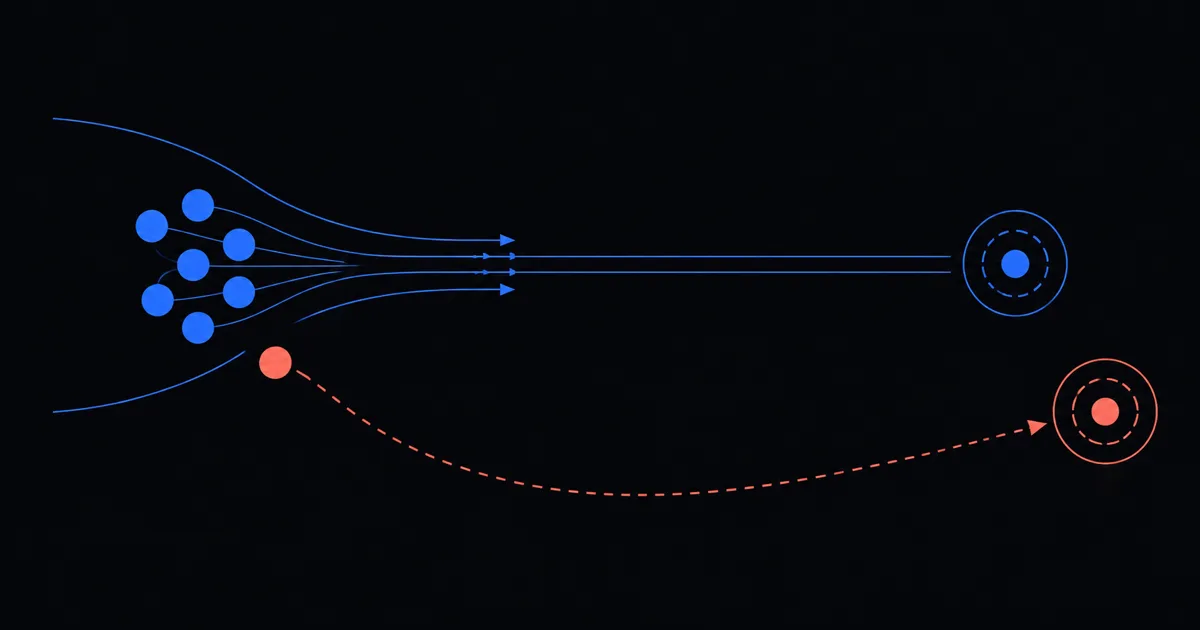
A prediction market price is a hard benchmark on average and a soft one in specific places. The price is most beatable when almost nobody is trading the question, when the information is not the kind traders watch, when the answer needs specialist knowledge, when the resolution rule says something different from the title, at the far ends of the probability scale, and where the price itself changes behaviour. Everywhere else, assume the price is right.
Which six situations are worth calling?
| # | Situation | What to check before you disagree | Documented example | Date |
|---|---|---|---|---|
| 1 | Thin market nobody is watching | Volume under a few thousand dollars, wide spread, price unchanged for days | 1.30 million Polymarket markets shared $61 billion of nominal volume | November 2022 to April 2026 |
| 2 | Slow reaction to news | A concrete public signal has landed and the price has moved less than the signal implies | Kalshi NBA contracts captured about 0.64 of a one-minute change in win probability on impact | study published 5 June 2026 |
| 3 | Question needs domain knowledge | The answer lives inside a closed group, not in the news flow | Robert Prevost traded under 1 percent on Kalshi and was elected pope | 8 May 2025 |
| 4 | Resolution wording nobody read | The rules text names a source or a window the title does not | Polymarket "suit before July" market, $237 million volume, resolved No | resolved 1 July 2025 |
| 5 | Longshot priced too high | Price under about 5 percent on an outcome with a real reference class | Favourite-longshot bias documented across large-scale betting data | NBER working paper, April 2010 |
| 6 | Reflexive market | The price is being quoted as evidence in the thing it is predicting | Four Polymarket accounts run by one trader spent over $28 million on the 2024 US presidential race | 24 October 2024 |
Every row below explains what to look for and what the evidence actually says.
1. Thin markets nobody is watching
A thin market is one where very little money has traded, so the price reflects the opinion of a handful of people rather than a crowd. Thin markets are the default, not the exception.
The Polymarket-v1 Database, an arXiv paper from June 2026 by Boka Qin and Rui Yang, archives 1.20 billion trades across 1.30 million prediction markets carrying $61 billion of nominal volume between 21 November 2022 and 28 April 2026. Spread evenly that is about $47,000 per market, and volume in prediction markets is not spread evenly: a small number of headline events carry most of it, which leaves the long tail with very little.
Liquidity is not just a comfort issue. In When Do Markets Fully Process Public Information?, published on arXiv on 5 June 2026, Giovanni Angelini and Luca De Angelis found that salient signals were absorbed quickly in liquid markets and showed substantially greater underreaction when liquidity was low. Thin markets are slower as well as noisier.
What to check: volume, the gap between the buy and sell price, and when the price last moved. If all three say nobody is home, your own work is worth more here than in a headline market.
2. Slow reaction to non-financial news
Prediction market prices move in the right direction almost immediately after news, and then keep moving. The gap between the first move and the full move is a window.
Angelini and De Angelis measured this precisely on 1,438 NBA games and 2,876 team-level contracts on Kalshi between 15 April 2025 and 25 May 2026, using 409,512 contract-minute observations. A one-minute change in the benchmark win probability was associated with only about a 0.64-for-one contemporaneous change in market prices. The shortfall predicted what came next: at the five-minute horizon, incomplete initial updating predicted roughly 2.0 percentage points of further price adjustment.
Sport is the cleanest place to measure this because the signal is timestamped and public. The mechanism is general. When a signal is not the kind of thing traders are watching for, a court filing, a technical committee agenda, a regulatory gazette, the delay is longer.
What to check: is there a specific, public, verifiable event that has already happened, and has the price moved less than that event implies.
3. Questions that need domain knowledge
Some questions cannot be answered by reading the news faster. The information sits inside a closed group, and no amount of trading volume conjures it up.
The 2025 papal conclave is the clearest recent case. Polymarket handled over $30 million and Kalshi over $10.6 million on the identity of the next pope, CNBC reported on 10 May 2025. Robert Prevost, elected Leo XIV on 8 May 2025, had gone into the conclave at under 1 percent on Kalshi. Of more than 33,000 conclave trades on Kalshi, only 416, worth about $450,000, were on Prevost. Tens of millions of dollars of trading produced a price that was almost maximally wrong, because the cardinals were not talking.
What to check: could a well-informed outsider have known this. If the answer is no, volume is not evidence of anything, and a specialist view is worth more than the price.
4. Resolution wording nobody read
A market resolves on its rules text, not on its title. The gap between the two is where money and reputation are lost.
Two documented cases from 2025 on Polymarket. A market asking whether Volodymyr Zelenskyy would be photographed or videotaped wearing a suit between 22 March and 30 June 2025 drew $237 million of volume and resolved No on 1 July 2025, with the UMA oracle citing the absence of a credible reporting consensus despite his appearance at the NATO summit in The Hague on 24 June. Three months earlier, a $7 million market on whether Ukraine would agree a minerals deal before April resolved Yes after a large UMA token holder voted it through, and Polymarket declined to refund, calling the settlement early rather than a market failure, as Cointelegraph reported on 26 March 2025.
Neither outcome required predicting the world better than the crowd. Both required reading the rules text and understanding who decides.
What to check: the resolution source named in the rules, the exact time window, and the dispute procedure. If your reading of the rules differs from the price, that is a real disagreement.
5. Longshots priced too high
At the far ends of the probability scale, prices drift away from the truth in a direction that has been documented for decades.
The favourite-longshot bias is the observation that very unlikely outcomes trade above their true probability while heavy favourites trade below theirs. Erik Snowberg and Justin Wolfers tested the two competing explanations in Explaining the Favorite-Longshot Bias, issued as an NBER working paper in April 2010 and published in the Journal of Political Economy the same year. Using a large-scale betting dataset covering win bets and compound bets, they concluded that misperception of small probabilities, as in prospect theory, fits the data better than a rational taste for risk.
Prediction markets are not horse tracks and the pattern is not identical there. Philipp Dubach's microstructure study of the Polymarket order book, posted to arXiv in April 2026 and based on 30 billion order-book events across 600 markets over 52 days, documents a longshot spread premium, meaning it costs more to trade at the extremes in the first place. Trading costs and mispricing both live at the ends of the scale.
What to check: whether an outcome priced at 2 or 3 percent has any real reference class supporting even that. Very cheap outcomes attract attention out of proportion to their odds.
6. Reflexive markets where the price changes the outcome
A reflexive market is one whose price feeds back into the thing being predicted. The price stops being purely an estimate and starts being a signal that people act on.
In October 2024, Polymarket confirmed that four accounts that had collectively spent over $28 million on Donald Trump to win the presidential election were controlled by a single French trader, CNBC reported on 24 October 2024. Polymarket said an investigation with third-party experts had found no information suggesting the user manipulated or attempted to manipulate the market. That is the point: no manipulation is required for a widely quoted price to become part of the story, and the odds gap was being cited at the time as evidence of momentum even while polls showed a close race.
Maksym Nechepurenko's Price as Focal Point, posted to arXiv in April 2026, argues from 2024 US election data that public probabilities organise the behaviour of voters, donors, journalists and institutions in ways that can be self-fulfilling or self-defeating, and reports that the most visible market produced the least accurate forecasts. The same direction is visible in the Clinton and Huang study of more than 2,500 political markets over the final five weeks of the 2024 campaign, posted 1 December 2025: 93 percent of PredictIt markets beat chance against 78 percent on Kalshi and 67 percent on Polymarket, so the largest and most quoted venue was the least accurate of the three.
What to check: is the price being used as an argument inside the event it is measuring. If yes, treat it as a crowd signal, not as an independent estimate.
How do you check which one you are looking at?
Run the list in order, because the cheap checks come first.
- Read the resolution rules before anything else. Situation 4 is decided by reading, not by forecasting.
- Check volume, spread and the timestamp of the last price move. That settles situation 1.
- Ask whether the answer is knowable from public information. If not, you are in situation 3 and the price is soft.
- Ask whether a specific public event has already happened that the price has not fully absorbed. That is situation 2, and it has a short shelf life.
- Check where on the scale the price sits. Under 5 percent or over 95 percent, apply situation 5.
- Ask whether the price is being quoted as evidence in the outcome. That is situation 6, and it is the hardest to trade against.
If none of the six applies, the honest answer is that you do not have a reason to disagree with the price, and the useful move is to say nothing.
Which events are open right now?
Open events right now
Live from insiderz.Democratic Presidential Nominee 2028
PoliticsCloses 0 calls
- Alexandria Ocasio-Cortez · Will Alexandria Ocasio-Cortez win the 2028 Democratic presidential nomination?
- Jon Ossoff · Will Jon Ossoff win the 2028 Democratic presidential nomination?
- Gavin Newsom · Will Gavin Newsom win the 2028 Democratic presidential nomination?
Presidential Election Winner 2028
PoliticsCloses 0 calls
- JD Vance · Will JD Vance win the 2028 US Presidential Election?
- Alexandria Ocasio-Cortez · Will Alexandria Ocasio-Cortez win the 2028 US Presidential Election?
- Jon Ossoff · Will Jon Ossoff win the 2028 US Presidential Election?
Republican Presidential Nominee 2028
PoliticsCloses 0 calls
- J.D. Vance · Will J.D. Vance win the 2028 Republican presidential nomination?
- Marco Rubio · Will Marco Rubio win the 2028 Republican presidential nomination?
- Tucker Carlson · Will Tucker Carlson win the 2028 Republican presidential nomination?
Brazil Presidential Election
PoliticsCloses 0 calls
- Luiz Inácio Lula da Silva · Will Luiz Inácio Lula da Silva win the 2026 Brazilian presidential election?
- Flávio Bolsonaro · Will Flávio Bolsonaro win the 2026 Brazilian presidential election?
- Augusto Cury · Will Augusto Cury win the 2026 Brazilian presidential election?
Next French Presidential Election
PoliticsCloses 0 calls
- Marine Le Pen · Will Marine Le Pen win the 2027 French presidential election?
- Édouard Philippe · Will Édouard Philippe win the 2027 French presidential election?
- Jean-Luc Mélenchon · Will Jean-Luc Mélenchon win the 2027 French presidential election?
On insiderz you can state a view on the same events Polymarket lists without putting up money. A call is a yes or no statement with your confidence attached, locked the second you post it with the time and the Polymarket price at that moment frozen beside it. Nothing can be edited or deleted. When the event resolves, the call is scored against that frozen price, so a disagreement with the price is either vindicated in public or it is not.
For the method behind picking which disagreements to act on, read how to beat the market. For how resolution actually works and why disputes happen, read how prediction markets resolve. For the evidence on how accurate market prices are overall, read are prediction markets accurate.
Questions people ask
- When are prediction markets least accurate?
- On low volume markets, on questions where the answer needs specialist knowledge rather than public news, in the minutes after a sudden headline, and where the resolution rule is written more loosely than the market title suggests.
- What is the favourite-longshot bias?
- The long-documented tendency for very unlikely outcomes to trade above their true probability and heavy favourites to trade below theirs. Snowberg and Wolfers traced it to misperception of small probabilities rather than a taste for risk.
- How do I find a market worth disagreeing with?
- Look for three things together: low volume, a price that has not moved despite new information, and a resolution rule you have read more carefully than the crowd has.
- Do prediction markets react instantly to news?
- Not fully. In a study of NBA contracts on Kalshi, prices moved in the right direction immediately but captured only about 0.64 of the statistical content of a one-minute change in win probability, with the rest arriving over the following minutes.
- Is a big market safer to disagree with than a small one?
- Not automatically. In the 2024 US presidential campaign, the platform with the largest volume had the lowest share of markets that beat chance, so size is not the same as accuracy.
Sources
- Giovanni Angelini and Luca De Angelis, When Do Markets Fully Process Public Information? Evidence from Real-Time Prediction Markets, arXiv, 5 June 2026
- Boka Qin and Rui Yang, Polymarket-v1 Database, arXiv, June 2026
- Philipp D. Dubach, The Anatomy of a Decentralized Prediction Market: Microstructure Evidence from the Polymarket Order Book, arXiv, April 2026
- Natalie Wu, Online bettors spent over $40 million gambling on the identity of the next pope, CNBC, 10 May 2025
- Polymarket Rules 'No' on $237M Controversial Bet Over Zelenskyy's Suit, Decrypt, 9 July 2025
- Zoltan Vardai, Polymarket faces scrutiny over $7M Ukraine mineral deal bet, Cointelegraph, 26 March 2025
- Erik Snowberg and Justin Wolfers, Explaining the Favorite-Longshot Bias: Is it Risk-Love or Misperceptions?, NBER Working Paper 15923, April 2010
- Maksym Nechepurenko, Price as Focal Point: Prediction Markets, Conditional Reflexivity, and the Politics of Common Knowledge, arXiv, April 2026
- Kevin Breuninger, French trader bet over $28 million on Trump election win using 4 Polymarket accounts, CNBC, 24 October 2024
- Joshua D. Clinton and TzuFeng Huang, Prediction Markets? The Accuracy and Efficiency of $2.4 Billion in the 2024 Presidential Election, SocArXiv preprint, 1 December 2025