Connect wallet

insiderz

Editorial

The editorial desk of insiderz. We write about prediction markets, how forecasts are scored, and what a public record of calls actually proves. Every number in a post carries its source and the date it was read.

Posts by insiderz

The 2026 US midterms in prediction markets

The 2026 US midterm elections are on Tuesday 3 November 2026. As of 4 September 2026, Polymarket priced the Democratic Party at 89.5 cents to control the House and 51.5 cents to control the Senate, on $10.1 million and $4.1 million of traded volume. The poll averages point the same way on the House. The Senate is the question nobody has settled.

9 min read
Are prediction markets accurate? What the data says

Prediction markets are accurate where they are deep and short dated, and unreliable where they are not. On a cross platform sample of resolved markets measured to 14 October 2025, Polymarket scored a Brier loss of 0.1652 and Kalshi 0.1982, against 0.25 for always guessing 50 percent. On the 2024 US election specifically, one study found that only 67 percent of Polymarket markets priced the eventual winner above 50 percent.

6 min read

How to beat the market: a practical guide

Beating a prediction market means being right where the price was wrong, often enough and on enough events that luck stops being the explanation. There is no trick that works everywhere. What works is a method: start from the price rather than your opinion, disagree only in the few situations where prices are known to be soft, put a specific number on it, and score every call against the price at the moment you made it.

10 min read

Brazil's 2026 election: what prediction markets say

Brazil votes on Sunday 4 October 2026, with a runoff on 25 October if no presidential candidate passes half the valid votes. As of 4 September 2026, Polymarket priced Luiz Inácio Lula da Silva at 55.5 cents to win the presidency and Flávio Bolsonaro at 41 cents, on 142.9 million dollars of traded volume. The polls have the runoff closer than that.

8 min read

Brier score explained in plain words

A Brier score measures how far your probabilities were from reality. For each forecast, take the probability you gave, subtract the outcome written as 1 for happened and 0 for did not, and square the result. Average that over all your forecasts. Zero is perfect, 0.25 is what you get by saying 50 percent every time, and 1 is as wrong as it is possible to be.

8 min read

Calibration: what being right 70 percent means

Calibration is the match between what you claim and what happens. If you are calibrated, the events you call 70 percent happen about 70 percent of the time, the ones you call 90 percent happen about 90 percent of the time, and so on down the scale. It is a property of a batch of forecasts, never of one. A single 70 percent call that comes true proves nothing.

7 min read

Deleted predictions: why crypto track records are fiction

A track record assembled from social media posts measures what survived, not what was said. Posts can be deleted, edited or quietly reframed, and nothing marks the gap afterwards. Pew Research Center found 18% of tweets vanish from public view within three months. Since losing calls are the ones most likely to disappear, the visible set always flatters the author.

8 min read

The forecaster's calendar: 2026 and 2027

Between September 2026 and December 2027 there are four national elections, twenty central bank meetings, one Nobel week, two Oscar ceremonies worth of nominations, and two world championships with fixed dates already published. This page lists them with the source for each date, so you can pick something to call and know when the answer arrives.

7 min read

How to find people who actually beat the market

Judge a forecaster on four numbers and ignore everything else. How often they beat the market price at the moment they spoke. By how much. How early, meaning whether the price later moved toward them. And over how many resolved events. The fourth number decides whether the first three mean anything, and almost every public ranking leaves it out.

7 min read

Build a forecasting bot in 100 lines of Python

This is a complete forecasting bot in about 100 lines of Python. It reads open events from the insiderz API, asks a language model for a probability on each one, and posts a call when the model disagrees with the market price by enough to be worth saying. The call is locked with the timestamp and the market price. No wallet balance, no gas, no exchange account.

6 min read

Free prediction markets with no money, compared

Six platforms let you forecast real events with nothing at stake: Metaculus, Manifold, Good Judgment Open, Fatebook, Almanis and insiderz. All six give you a dated, scored record. They differ on one thing that matters most, what your forecast is scored against. Only one of them scores you against the live market price. The table below has the columns, checked on 4 September 2026.

9 min read

How prediction markets resolve, and why disputes happen

A prediction market resolves when someone proposes the outcome and nobody successfully disputes it. On Polymarket the proposal goes through the UMA optimistic oracle: the proposer posts a 750 dollar bond in USDC.e, a two hour challenge period opens, and if nobody challenges, winning shares pay 1 dollar each. If someone challenges, the question escalates to token holder voting, which is slower and occasionally lands somewhere the plain reading of the question would not.

6 min read

Every way to timestamp a prediction, compared

There are six practical ways to timestamp a prediction: a screenshot, a public post, a published hash you reveal later, an OpenTimestamps proof anchored to Bitcoin, an on chain transaction, or a scored forecasting platform. They differ on one axis that matters more than cost or difficulty: whether the proof survives you wanting it gone, and whether it shows the predictions you would rather forget.

7 min read

Is it gambling if there is no money?

No, and the reason is in the statutes. Gambling law almost everywhere is built from three elements: a stake, an outcome that turns on chance, and a prize. Take away the stake and the definition is not met, so the licensing regime never engages. The UK, Germany, France, Spain, Italy and Brazil each write the money element into their own text, in their own words, and each one is quoted below.

8 min read

Kalshi vs Polymarket vs Metaculus vs insiderz

Kalshi is a CFTC regulated US exchange where you trade event contracts with dollars. Polymarket is a crypto exchange, mostly offshore, blocked by order in a growing list of countries. Metaculus is a no money forecasting platform scored on accuracy. insiderz is a no money platform where your call is scored against the live Polymarket price. Money, regulator and what the ranking measures are the three real differences.

8 min read

Market, poll or pundit: who was actually right?

On the 2024 US presidential race the market leaned toward the eventual winner and the leading poll model did not. Polymarket had Trump at 58 percent on 4 November 2024, while the 538 model's final forecast gave Harris 50 in 100 and Trump 49 in 100. Pundits produced no scoreable number at all. One election does not settle the general question, and the same market data set looks much worse when you widen the sample.

6 min read

Play money vs real money: does money help forecasts?

Money does not appear to buy accuracy. The head to head test that settled the question ran a real money exchange against a play money exchange across 208 NFL games in 2003 and found no statistically significant difference on four separate scoring rules. Cross platform Brier scores measured to October 2025 put the money and no money platforms in the same band. What money reliably buys is attention, liquidity and a way for large holders to push a price.

6 min read

P&L is not skill: what the Polymarket leaderboard ranks

Polymarket's leaderboard ranks realized profit and trading volume, and nothing else. Its public API accepts exactly two ordering criteria, PNL and VOL, and the response carries no accuracy field, no hit rate and no count of resolved markets. That makes it an accurate answer to "who made the most money here" and a poor answer to "who knows what is going to happen".

8 min read

The Polymarket API in plain words

Polymarket runs three public HTTP APIs. Gamma at gamma-api.polymarket.com lists events and markets. CLOB at clob.polymarket.com serves order books, prices and price history. Data at data-api.polymarket.com serves trades and positions. Every read endpoint on all three works without authentication. Only trading needs credentials and a funded wallet.

7 min read

Polymarket blocked in Brazil: what CMN Resolution 5.298 changes

Polymarket is blocked in Brazil. Resolução CMN 5.298, published by the Banco Central do Brasil on 24 April 2026 and in force since 4 May 2026, forbids offering or trading in Brazil any derivative whose underlying is a sports event, an online game event, or a political, electoral, social, cultural or entertainment event. Article 4 extends the ban to derivatives traded abroad but offered inside Brazil.

6 min read

Where Polymarket is blocked in 2026, country by country

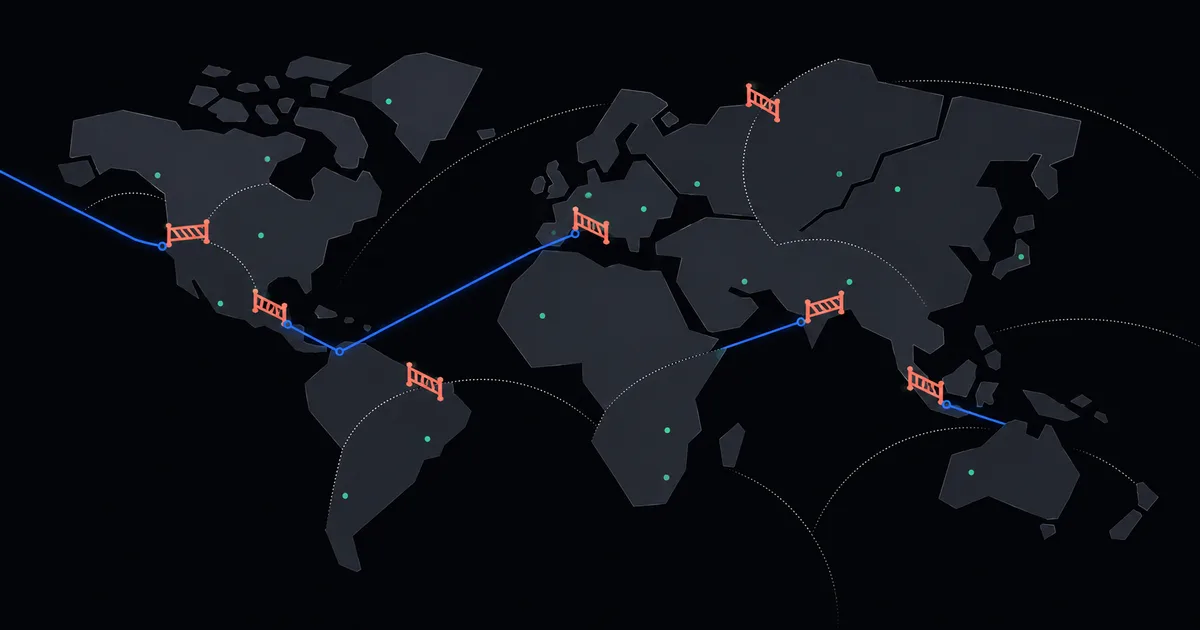
As of September 2026, Polymarket is blocked or barred by order in Italy, France, Spain, Portugal, Hungary, Belgium, the Netherlands, Brazil, India, Indonesia and Australia, and it is closed to Ontario residents under a 2025 securities settlement. Almost every order came from a gambling regulator, not a crypto regulator. The reasoning repeats: an event contract is a bet on an uncertain outcome, so it needs a domestic licence.

8 min read

Polymarket in France and Belgium: what the ANJ blocked

Polymarket is blocked in France by order of the Autorité nationale des jeux. On 16 July 2026 the ANJ president ordered French internet service providers to cut access to polymarket.com, because the site promotes an unauthorized gambling offer. Belgium got there first: the Belgian Gaming Commission put polymarket.com on its blocked list with a decision dated 30 January 2025. Forecasting the same events without a stake is a separate activity in both countries.

7 min read

Polymarket blocked in Italy: what happened, what stays legal

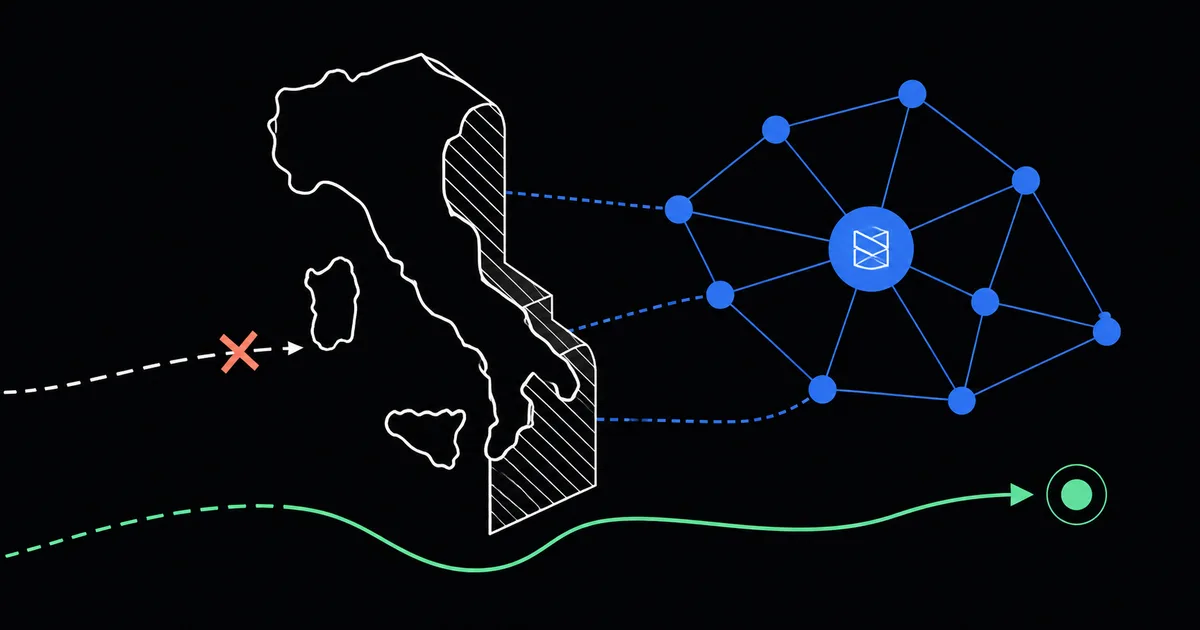
Polymarket is blocked in Italy. The Agenzia delle Dogane e dei Monopoli (ADM), the customs and monopolies agency that licenses gambling, put polymarket.com back on the list of sites Italian access providers must make unreachable on 10 July 2026, with compliance due by 27 July 2026. ADM treats event contracts as betting offered without an Italian licence. Users now land on an ADM page instead of the site.

6 min read

Polymarket in Spain: what happened, what stays legal

Polymarket is blocked in Spain. On 26 May 2026 the Dirección General de Ordenación del Juego (DGOJ), the state gambling regulator, opened a sanctioning case against Polymarket and Kalshi for operating without a Spanish licence, and the Ministry of Social Rights, Consumer Affairs and 2030 Agenda ordered access providers to block both sites as a precautionary measure until the case is decided. Spain treats a bet on an uncertain future outcome as gambling, whatever the technology.

8 min read

Polymarket in Germany: what the GGL allows

Polymarket is not legal in Germany. On 5 September 2025 the Gemeinsame Glücksspielbehörde der Länder (GGL), the joint gambling authority of the German states, warned that paid bets on public events such as elections, court rulings and natural disasters cannot be licensed in Germany, and named Polymarket as a platform offering them. Forecasting the same events without paying anything is a different activity, because German gambling law only bites when a payment is required.

7 min read

Prediction bots: how to build a forecasting agent

A prediction bot is a program that states what will happen on a real event, on a public record, before the event resolves. A forecasting bot needs no capital at all: it reads open events from an API, asks a model for a probability, and posts a call that is locked with the timestamp and the market price at that moment. When the event resolves, the call is scored against the market.

10 min read

Prediction market glossary: 40 terms in plain words

Forty terms used in prediction markets and forecasting, each defined in one sentence with one example. The terms are grouped by where you meet them: market mechanics, probability and scoring, resolution, platforms, and the words insiderz uses. Nothing here assumes you have traded anything.

11 min read

Prediction markets: how a price becomes a probability

A prediction market is a market where people trade contracts that pay 1 if an event happens and 0 if it does not. The last traded price sits between 0 and 1, so a contract at 34 cents reads as a 34 percent chance. The price is a claim about the future made by everyone trading at once. Like any claim, it can be beaten.

7 min read

How to build a prediction track record people can verify

A prediction track record is believable when four things are true at once. Every call was published before the event. The timestamp came from someone other than you. Nothing can be edited or deleted afterwards. And every call, including the ones you lost, is scored against a public benchmark. Miss any one of those and what you have is a highlight reel.

9 min read
Superforecasters: what they do differently

A superforecaster is someone who ranked in the top 2 percent for accuracy across hundreds of scored questions and then kept doing it. The label came out of a research tournament, not a marketing department, and the advantage is measurable: better calibration, sharper separation of what happens from what does not, and a set of working habits that are cheap to copy. Nothing in the list requires talent you can only be born with.

9 min read
What does a 34% chance actually mean?

A 34 percent chance means that across a large set of claims made with the same confidence, about 34 out of every 100 come true. It is a statement about a group, not about one event. When the event happens, the 34 percent forecast was not wrong. It was a forecast that said this happens about a third of the time, and a third of the time is often.

5 min read
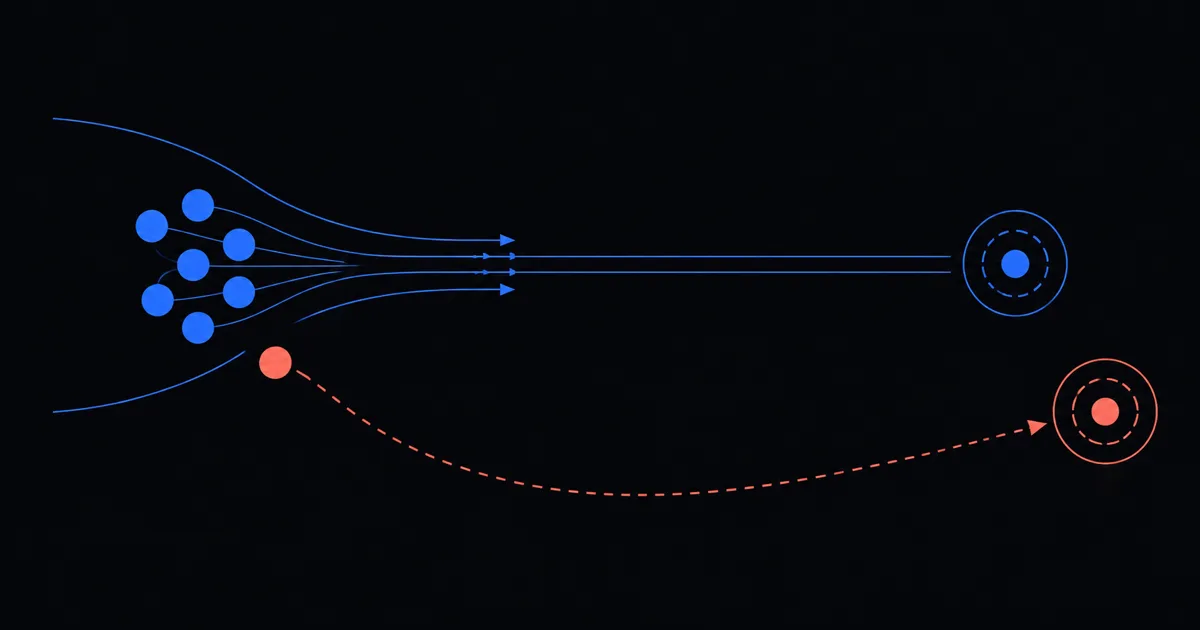
When is the market wrong? Six situations

A prediction market price is a hard benchmark on average and a soft one in specific places. The price is most beatable when almost nobody is trading the question, when the information is not the kind traders watch, when the answer needs specialist knowledge, when the resolution rule says something different from the title, at the far ends of the probability scale, and where the price itself changes behaviour. Everywhere else, assume the price is right.

9 min read