What does a 34% chance actually mean?
By insiderz5 min read
A 34 percent chance means that across a large set of claims made with the same confidence, about 34 out of every 100 come true. It is a statement about a group, not about one event. When the event happens, the 34 percent forecast was not wrong. It was a forecast that said this happens about a third of the time, and a third of the time is often.
Why is "it happened, so the forecast was wrong" wrong?
A probability is not a prediction of the outcome. It is a rate. Saying an event is 34 percent likely is saying that if you lined up every claim you have ever made at 34 percent, roughly a third of them would come true. The only way to be wrong is to be wrong about the rate.
This is why a single result cannot settle an argument about a forecast. If a weather service says 30 percent rain and it rains, the service is not exposed. If it says 30 percent rain on 200 days and it rains on 120 of them, it is exposed, badly.
The confusion is not harmless. It is the reason people conclude that markets and models "failed" whenever a favorite loses, and the reason confident wrong takes survive: nobody keeps the tally.
What does 34 percent look like over 100 events?
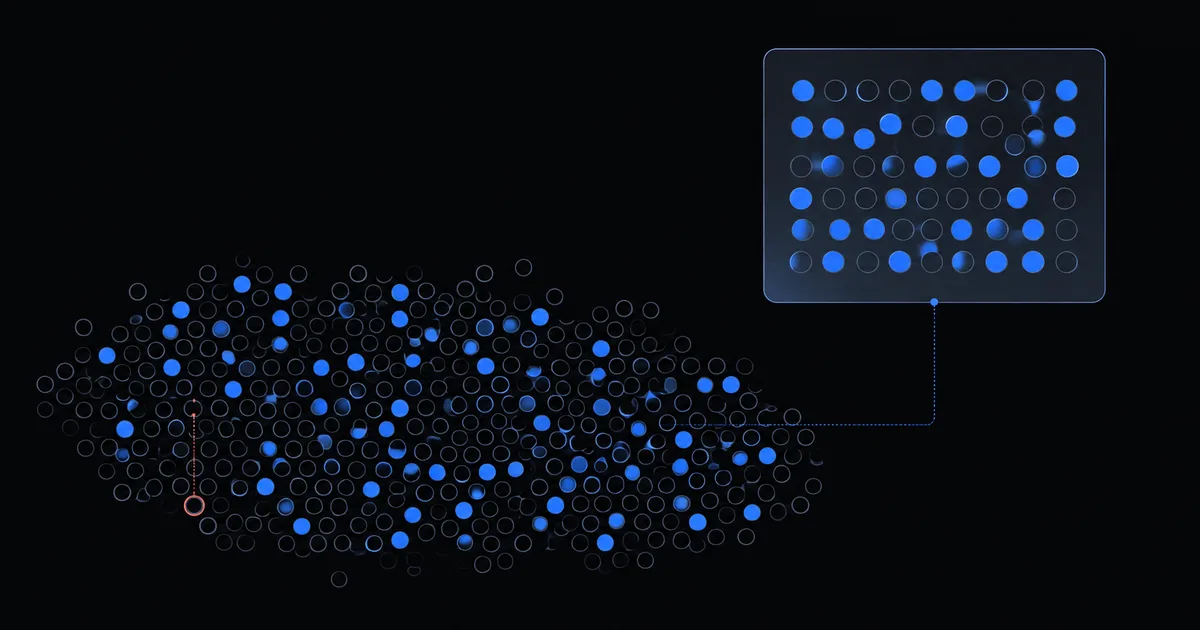
Take 100 claims made at 34 percent. About 34 happen. About 66 do not. Both groups are large. Neither is a surprise.
Now push the number around. At 10 percent, 1 in 10 still happens, so seeing one is normal. At 90 percent, 1 in 10 still fails, so a shock result every ten claims is exactly what 90 percent predicts. A forecaster whose 90 percent claims never fail is not brilliant. They are underconfident, and they are leaving accuracy on the table by not saying 97 when they mean 97.
The two properties worth naming:
- Calibration. Your 70 percent claims come true about 70 percent of the time. Full explanation in calibration explained.
- Sharpness. Your claims move away from 50 percent when the evidence lets them. A forecaster who says 50 percent to everything is perfectly calibrated and completely useless.
How do you read a market price as a probability?
On a prediction market, a contract pays 1 if the event happens and 0 if it does not, so the price is the crowd's probability. Thirty four cents is 34 percent. Fifty cents is a coin flip. The mechanics are in how a price becomes a probability.
Prices are close to probabilities, not identical to them. A 2026 study of 353 million trades across 429,000 binary contracts on Kalshi and Polymarket found political market prices are chronically compressed toward 50 percent, so a contract at 70 cents a month before resolution corresponded to a true probability nearer 75 percent (Le, arXiv:2602.19520, February 2026). The correction is small, it has a direction, and it is bigger the further out the question sits.
What did 2024 look like when read this way?
The 2024 US presidential race is the cleanest recent example of a probability being mistaken for a prediction. Two respected numbers disagreed, both were defensible, and only one outcome happened.
| Forecast | Date | Probability given to a Trump win | Outcome | Was the forecast "wrong"? |
|---|---|---|---|---|
| 538 model | 5 November 2024 | 49 in 100 | Trump won | No, 49 percent events happen about half the time |
| Polymarket price | 4 November 2024 | 58 percent | Trump won | No, a favorite winning is the expected case |
Sources: 538's final forecasts, ABC News, 5 November 2024, which put Harris at 50 in 100 and Trump at 49 in 100, and Fortune, 4 November 2024, which recorded Polymarket at 58 percent for Trump at 1:35 pm ET the day before the vote.
The lesson people took was "the model was wrong and the market was right". The correct reading is narrower. One election is one data point. A 49 percent forecast and a 60 percent forecast are barely distinguishable on a single result. You need dozens of resolved questions before you can rank two forecasters, which is exactly why track records matter more than takes.
How do you check your own sense of 30 percent?
Write the number down before the outcome, then count.
- Pick a set of questions with a fixed resolution date.
- Give each one a probability, not a yes or a no.
- Wait. Do not edit.
- Group your answers into bands: 0 to 10, 10 to 20, and so on.
- In each band, check what fraction actually happened.
If your 70 percent band comes true 45 percent of the time, you are overconfident. If it comes true 92 percent of the time, you are underconfident and should be saying 90. Most people discover the first problem.
The bar to compare against is public. On the ForecastBench human question set, superforecasters reached a mean Brier score of 0.096, the general public 0.121, and the strongest large language model tested 0.122, with the gap between superforecasters and both others statistically significant at p below 0.001 (Karger et al., arXiv:2409.19839, revised February 2025). A Brier score of 0.25 is what you get by saying 50 percent to everything. Lower is better. Brier score explained unpacks the arithmetic.
What gets scored instead of right and wrong?
On insiderz, a call is a yes or a no on a real event plus how sure you are. The moment you post it, the call is locked with the time and the Polymarket price for that event at that instant. It cannot be edited or deleted.
When the event resolves, the call is scored against the price it was locked at, not against your gut and not against hindsight. Agreeing with a 90 cent favorite and being right earns very little. Saying yes at 34 cents and being right is what moves the record. The leaderboard shows four columns: Beats market, Events, Edge and Early. There is no money in it. insiderz launched in September 2026, so every record on it is still short.
What should you do with a 34 percent price you disagree with?
State your own number and let it resolve. If you think a market at 34 cents should be at 60, that disagreement is only worth something once it is written down with a timestamp on it, and only worth ranking once you have done it across many events. Open events are on Events, and calls made on them appear in Calls after their delay expires.
Questions people ask
- Is a 30 percent forecast wrong if the event happens?
- No. A 30 percent forecast is wrong only if events like it happen much more or much less often than 30 percent of the time. One outcome tells you almost nothing.
- How do you judge a single probability forecast?
- You cannot, reliably. You need a run of forecasts, and you check how often each confidence band came true.
- What is a good probability forecast?
- One that is calibrated, meaning 70 percent claims come true about 70 percent of the time, and sharp, meaning it moves away from 50 percent when the evidence allows.
- Does a 34 percent chance mean the event probably will not happen?
- It means it happens about a third of the time. Roughly one in three. That is common, not rare.
Sources
- 538's final forecasts for the 2024 election, ABC News, 5 November 2024
- Polymarket users who bet on the presidential election might not see pay day until the inauguration, Fortune, 4 November 2024
- ForecastBench: A Dynamic Benchmark of AI Forecasting Capabilities, Karger et al., arXiv:2409.19839, revised 28 February 2025
- Decomposing Crowd Wisdom: Domain-Specific Calibration Dynamics in Prediction Markets, Nam Anh Le, arXiv:2602.19520, February 2026